
If you are building a shortlist of Intralinks competitors in 2026, ten names come up again and again: Ideals, Datasite, DealRoom, Firmex, Ansarada, Drooms, SecureDocs, Digify, DFIN Venue and ShareVault. They solve different problems. Ideals is the first to look at for an easy-to-use due diligence room with built-in AI and an MCP link to Claude, ChatGPT or Copilot. Datasite fits the largest deals. DealRoom suits corporate development teams that track diligence inside a pipeline. Firmex makes sense for advisers who open a new room every other week.
SS&C Intralinks stays in this guide as the yardstick, because most readers compare against a quote they already hold. A dedicated section sets each provider against it, from Ideals vs Intralinks to ShareVault vs Intralinks. Review scores are G2 figures taken on 1 November 2026 unless noted.
Top 10 Intralinks competitors overview
We compared each platform on permissions, upload and indexing, Q&A, buyer tracking, AI, price predictability, setup and support. We did not score them, so treat the table as a map and not a league table. Feature claims come from vendor documentation and 2025–2026 release notes. Review figures come from dated G2 and Capterra listings.
Intralinks and 10 alternatives compared
| Provider | Best for | Main differentiator vs. Intralinks | Pricing model |
|---|---|---|---|
| SS&C Intralinks (baseline) | Bank-led, complex transactions | VDRPro for the room, DealCentre AI for the wider deal | Custom contract |
| Ideals | M&A and due diligence | Ease of use, 24/7 support, MCP link to outside AI assistants | Quote-based, plan-dependent |
| Datasite | Enterprise M&A | Full deal lifecycle, Blueflame AI, MCP server | Custom quote |
| DealRoom | Corporate development | Pipeline, diligence and integration in one workspace | Annual, deal-volume-based |
| Firmex | Advisers with many projects | Per-project or unlimited-room subscription | Per project or subscription |
| Ansarada | Sell-side auctions | Deal readiness and bidder analytics | Storage-based tiers |
| Drooms | European M&A and real estate | AI assistant running on EU servers | Plan-based |
| SecureDocs | Straightforward due diligence | Published flat fee and quick setup | Flat fee |
| Digify | Secure document sharing | Tracking and control after files are shared | Published subscriptions |
| DFIN Venue | Capital markets deals | Link to SEC filing workflows | Custom quote |
| ShareVault | Life sciences and IP | Specialist templates and AI redaction | Tiered, quote-based |
What is SS&C Intralinks, and why consider alternatives?
Where Intralinks performs well
Intralinks helped create the commercial virtual data room. SS&C Technologies bought it from Siris Capital for $1.5 billion, and the deal closed on 16 November 2018. Shortlists often treat the AI platform and the data room as one product. They are two. VDRPro is the data room. DealCentre AI covers the wider process: preparation, buyer marketing, diligence and deal management.
DealCentre AI runs on Link, Intralinks’ own AI engine. With Ask Link, an authorised user types a question and gets an answer with clickable page references, drawn only from documents that person may already see. For outside tools, DealCentre Connect gives supported third-party AI a gateway that keeps permissions and audit trails. Hebbia, Harvey and Legora announced integrations during 2026.
In an April 2026 benchmark Intralinks ran with Reuters, 49% of 400 dealmakers said AI was fully integrated across deal stages. Because Intralinks commissioned it, read it as vendor research. Our SS&C Intralinks review covers the products in more detail.
What may lead teams to another VDR
Nothing below is a defect in the product. Reviews and contract questions point to a few recurring reasons for comparing:
- Contract terms are hard to line up. Intralinks prices by custom quote. Third-party sources report page-based billing in some contracts, and a 2025 Intralinks release note describes a usage widget showing page-count conversion ratios. Ask exactly how usage is metered.
- Cost and interface comments on VDRPro. G2 reviewers list high cost and interface design among the drawbacks.
- Two products, two review profiles. On G2, DealCentre AI sits at 4.7 from 119 reviews and VDRPro at 3.8 from 31. A quote for one tells you little about the other.
- Workflow mismatch. A buyer running tuck-in deals may want pipeline tools. A small seller may not need an enterprise process.
The 10 best Intralinks alternatives in 2026
The order below reflects how often each platform fits a mid-market or enterprise deal, not a scored ranking. Ideals comes first because it has the largest review base of the ten and a well-documented MCP connection. Every profile uses the same labels, so you can compare like with like: who it is for, what stands out, what to check before signing, how it is priced, and what reviewers say. G2 scores are from 1 November 2026 unless noted.
1. Ideals: best for secure, user-friendly M&A due diligence
Best for: M&A advisers, investment banks, private equity teams and corporate finance groups running sell-side or buy-side due diligence. Fundraising and real estate teams also use it.
What it is: Ideals is a virtual data room sold on storage-based plans (Core, Premier and Enterprise). It offers eight permission levels, a due diligence checklist, structured Q&A, e-signature and 24/7 support. Its security credentials include ISO 27001, 27017 and 27701, plus ISO 27018 and TX-RAMP added in September 2026, alongside SOC 2, SOC 3, GDPR and HIPAA compliance. Our Ideals data room review covers plans and the trial.
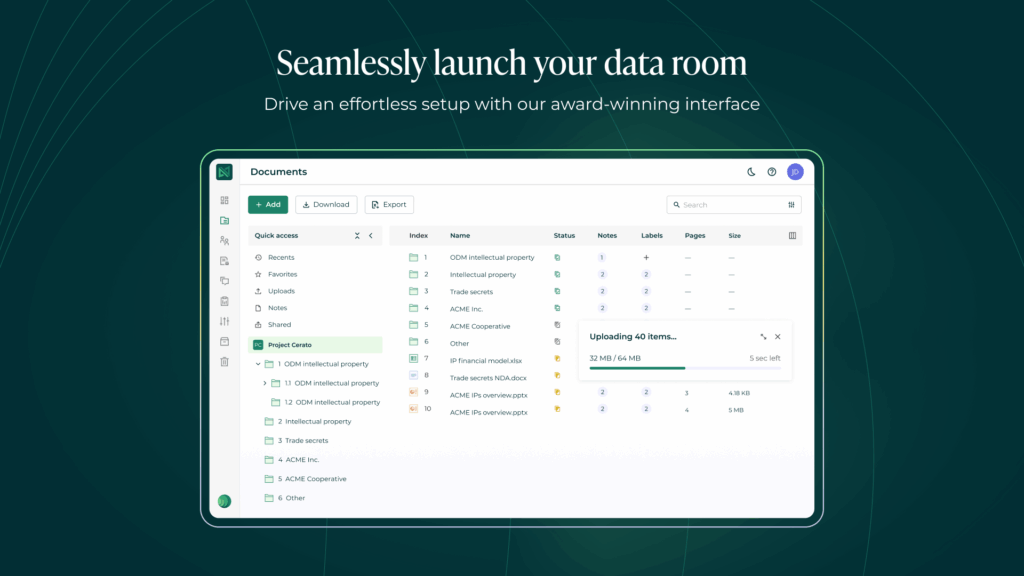
What stands out: The feature to study is MCP. In 2026, Ideals introduced MCP connectivity so that Claude, ChatGPT or Microsoft Copilot can work inside a live room instead of on exported copies. Picture a sell-side team on a €200 million manufacturing sale. An associate asks the assistant to build the folder index, check whether the room is complete against best practice, or list every document that mentions indemnification. The assistant acts under that associate’s permissions, and each step appears in the audit trail.
Ideals states that deal data is never used to train external models. Setup takes three steps: enable the AI tool in Settings, add Ideals as a connector in the assistant, then start asking. Product updates in August and September 2026 added AI folder creation, faster document search and AI duplicate detection in Q&A. Combined with MCP, this makes Ideals a relevant option for mid-market due diligence.
What to check: G2 reviewers describe the price as relatively high, and some ran into storage limits that triggered unexpected fees. A few find Q&A and file management cumbersome. Ask which AI functions each plan includes and what happens when you exceed your storage tier.
Pricing: Quote-based, tied to storage and plan. A free trial is available.
Reviews: 4.7 out of 5 from 864 G2 reviews.
2. Datasite: best for complex, enterprise-scale transactions
Best for: Large, multi-party M&A where thousands of documents move through several advisers and bidders.
What it is: Datasite is a platform that covers the deal from preparation to diligence. It is the nearest like-for-like rival to Intralinks. Its modules include Prepare, Diligence and Outreach, and our Datasite review lists them.
What stands out: Datasite bought Blueflame AI in July 2025. In April 2026 it launched an MCP server and described itself as the first VDR provider with MCP-based connectivity. Claude, ChatGPT, Copilot and Blueflame can all work on live room content.
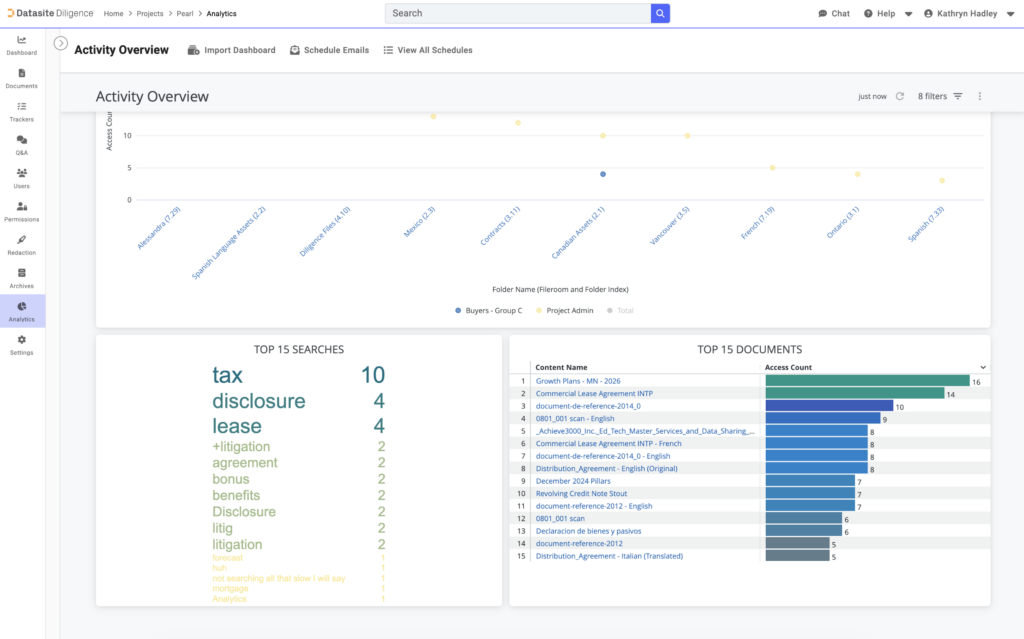
G2’s product listing describes AI redaction that finds sensitive terms across the room, semantic search, OCR in 17+ languages, and Blueflame drafts of buyer-question answers with cited sources. Near real-time reporting tracks activity down to the page level. In practice, a seller can see which bidder spent time on the customer contracts before a management meeting.
What to check: Datasite also owns Firmex and Ansarada, which keep their own brands. G2 reviewers call the price high compared with smaller rivals and mention slow uploads of large files, a learning curve and laborious access-control setup. Ask for a trial of your own file mix.
Pricing: Custom quote. Third-party contract data suggests average annual spend in the tens of thousands of dollars, so confirm in writing.
Reviews: 4.5 out of 5 from 451 G2 reviews.
3. DealRoom: best for corporate development and repeat acquisitions
Best for: Corporate development teams and serial acquirers who manage several deals at once.
What it is: DealRoom (dealroom.net) is a workspace first and a data room second. Around the room it adds pipeline stages, diligence requests, task lists and post-deal integration worklists. It is not Dealroom.co, the Amsterdam market-intelligence platform with a similar name. Our DealRoom review covers the modules.
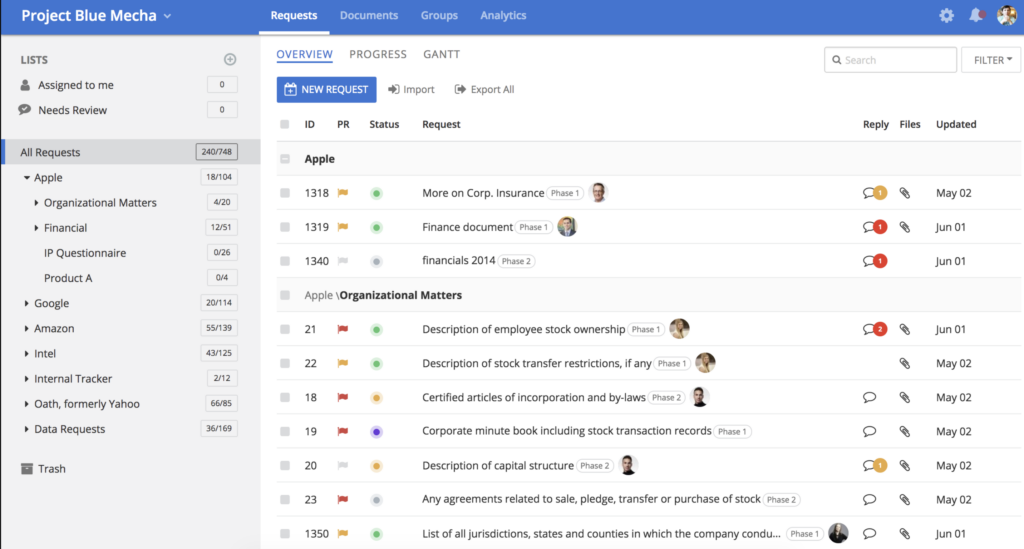
What stands out: A buyer evaluating six targets can see each one’s diligence status in a single view, assign requests to named owners and carry findings into integration planning. That removes the mid-deal switch between a data room, a tracker and a spreadsheet. Its AI features centre on diligence and contract analysis.
What to check: The pricing model suits repeat buyers more than a one-off seller. DealRoom charges by deal volume on an annual commitment, with unlimited users and storage and no per-page fees. A founder selling the company once may pay more per deal than on a simple room. G2 review volume is modest, so ask for references.
Pricing: Quote required. No public starting price.
Reviews: Comparison pages in 2026 report 4.3 on G2 (66 reviews) and 4.6 on Capterra (247 reviews). Check the live listings.
4. Firmex: best for advisers managing multiple data rooms
Best for: Advisory firms, law firms and mid-market teams that open many rooms across the year.
What it is: Firmex started in Toronto in 2006 and is known for straightforward rooms and strong support. The company says it opens more than 20,000 new rooms a year. It lists SOC 2, GDPR and HIPAA compliance, SSO, an API, Q&A, View As and redaction.
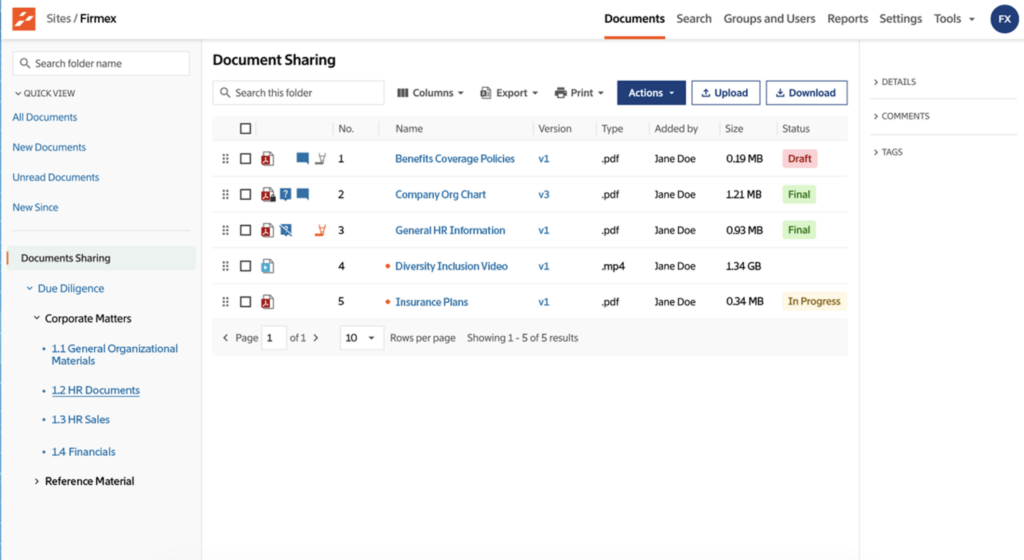
What stands out: Firmex offers a billing choice. You can pay per project, or take an unlimited-rooms annual subscription. It also lets you upload whole folder structures or replicate a previous project. A corporate finance boutique with eight mandates can clone its standard diligence index for each new client and avoid eight separate quotes.
What to check: Datasite has owned Firmex since 2021, though it still sells as its own product. G2 reviewers mention a dated interface, slow navigation in very large folders and limited dashboard customisation. We could not verify a public AI assistant or MCP connector as of November 2026. That does not prove none exists, so ask for a demo.
Pricing: Quote required, per project or by subscription.
Reviews: 4.6 out of 5 from 93 G2 reviews.
5. Ansarada: best for auction preparation and deal readiness
Best for: Sell-side auctions and private equity exits where bidder behaviour drives decisions.
What it is: Ansarada has built deal-preparation tools since 2005. It offers Ask AiDA (an AI assistant), AI-Sort (automatic indexing) and AI-Redact (bulk redaction). It also scores how ready a room is before buyers arrive.
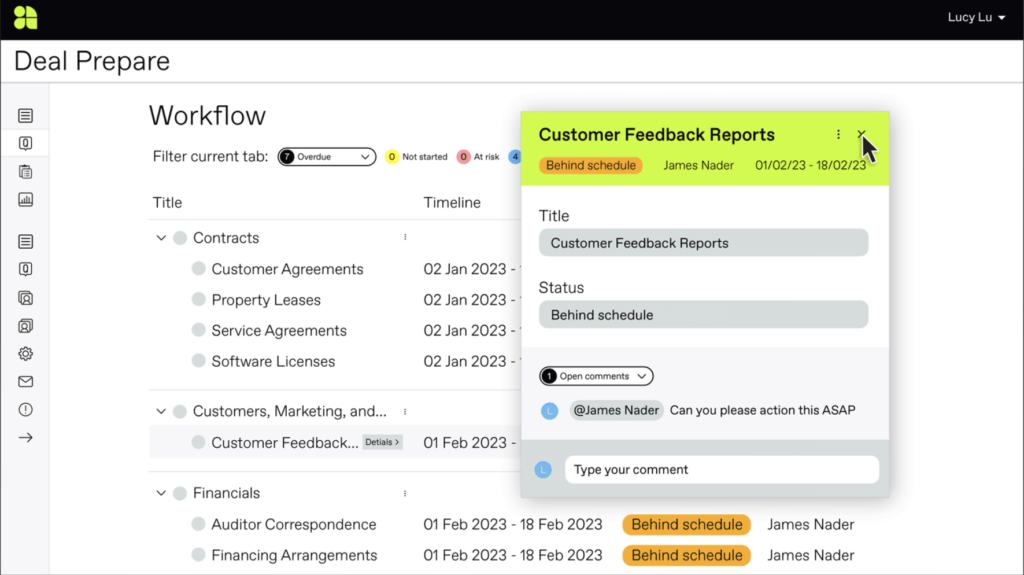
What stands out: Preparation and storage are free until you invite a bidder, so a team can build a room carefully without paying for idle months. The company also claims it can predict bidder outcomes with up to 97% accuracy. That is a vendor claim, so test it against your own process before relying on it. The practical value is engagement tracking: seeing which of six bidders is still reading the financials and which has gone quiet.
What to check: Datasite agreed to buy Ansarada in 2024. G2 reviewers call it expensive for small projects and mention slow performance and search glitches. Storage tiers can jump, so check overage terms.
Pricing: Storage-based tiers, displayed on the vendor’s site.
Reviews: 4.5 out of 5 from 238 G2 reviews.
6. Drooms: best for European M&A and real estate
Best for: European M&A and property transactions, especially where the legal team asks where AI processing happens.
What it is: Drooms is a Frankfurt-based data room with a long record in European real estate and asset-heavy deals. Its AI layer is called Drooms Intelligence.
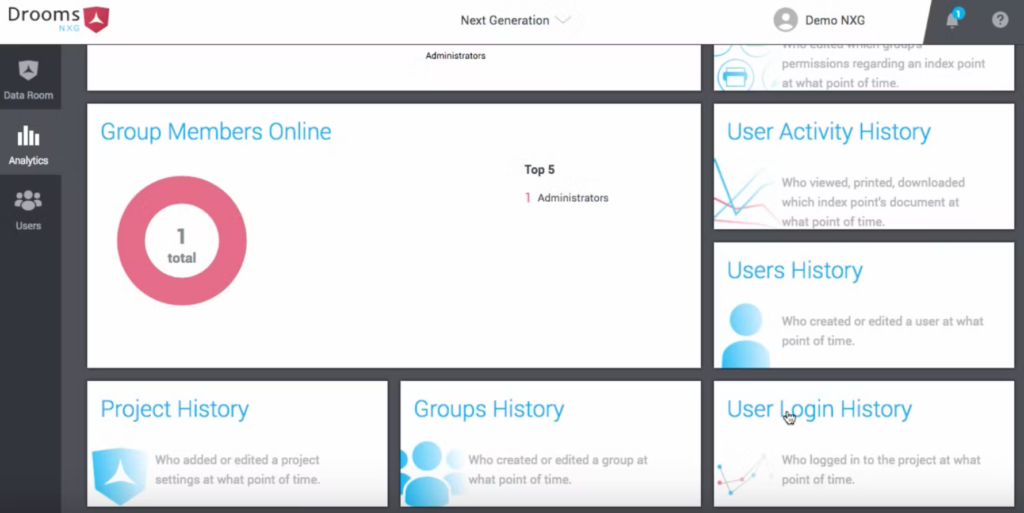
What stands out: Users can chat with the whole room in their own language, summarise documents, identify risks and analyse numerical data. A property buyer could ask which supplier agreements contain automatic renewal clauses and receive answers linked to the exact paragraph in the source PDF. Drooms says the AI runs on EU servers and that live data is never used to train its models.
What to check: Verify hosting, subprocessors and AI processing scope in the contract, since those claims come from the vendor. Third-party guides list ISO 27001 and 27018. Public review volume is small, so ask for client references.
Pricing: Plan-based. A 2026 comparison reports a free starter tier, so confirm current plans.
Reviews: Too few public reviews for a reliable score.
7. SecureDocs: best for straightforward due diligence
Best for: Small sales, fundraises and audits with a handful of reviewers and a modest document set.
What it is: SecureDocs is a flat-fee data room founded in 2012 and now part of Onit. It lists Q&A, e-signature and an API, with 256-bit encryption in transit and at rest.
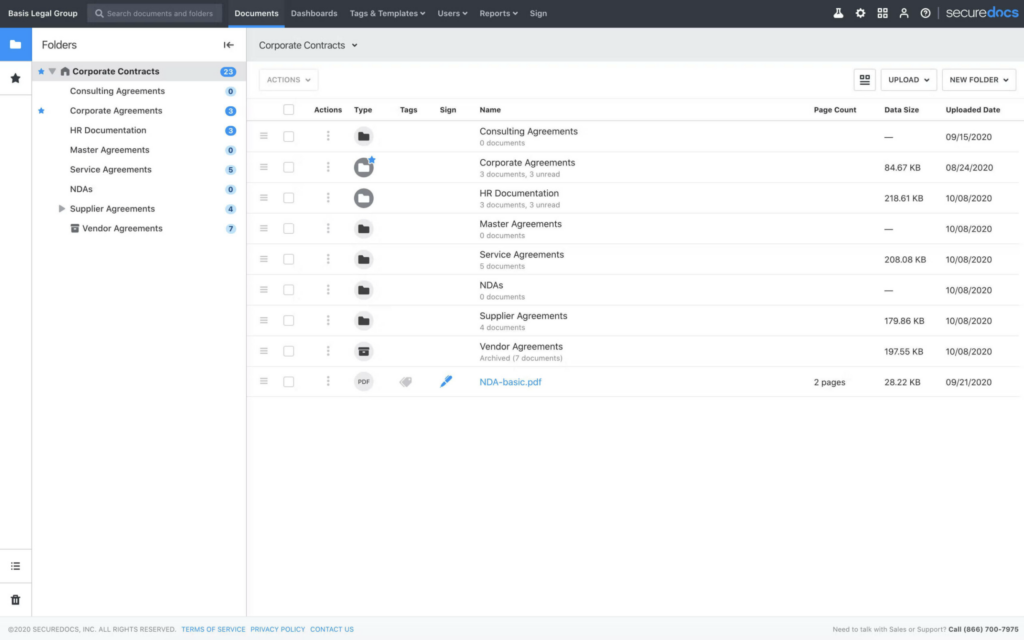
What stands out: Cost and speed. SecureDocs publishes flat-fee pricing from $250 a month with unlimited users, unlimited documents and 24/7 support. You can set up a room without a sales call, which suits a 30-document sale to a single buyer.
What to check: Reviewers do not list AI tools or built-in redaction, and it is lighter for cross-border auctions with many bidder groups. If your deal needs AI-assisted indexing or clean-team workflows, look at the platforms above.
Pricing: Flat fee from $250 a month, vendor-published.
Reviews: 4.9 out of 5 from 158 Capterra reviews. A 2026 comparison reported about 4.6 on G2 from roughly 50 reviews.
8. Digify: best for secure document sharing and tracking
Best for: Founders, investors and consultants who need control over files after sharing and a record of who opened them.
What it is: Digify, founded in 2011 and based in Singapore, combines document rights management with data room features. It offers watermarks, expiry dates, view limits and tracking.
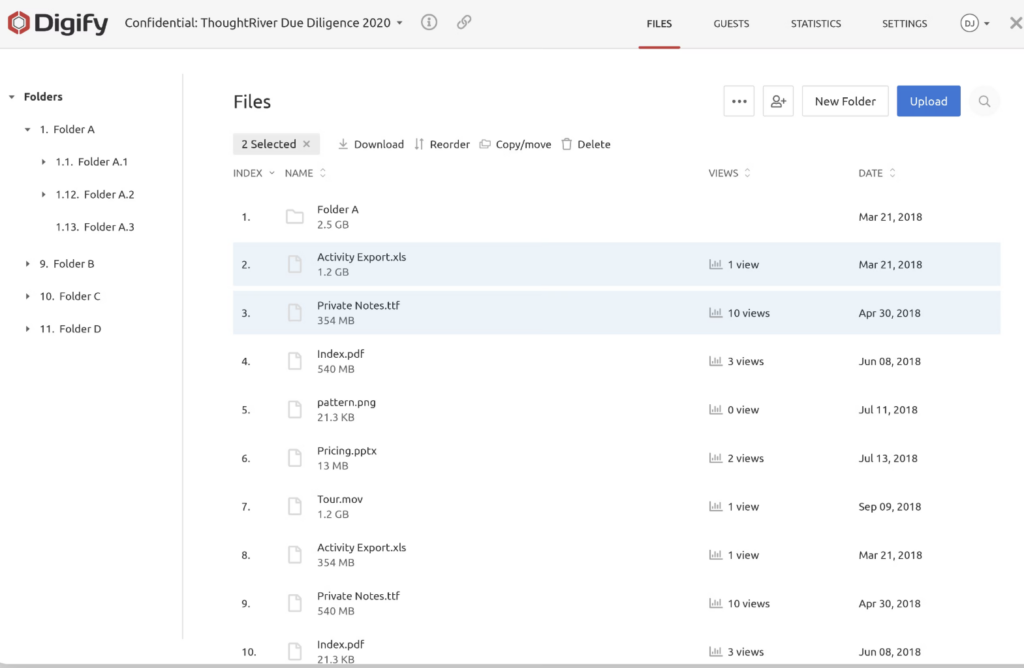
What stands out: You can share a pricing model with an investor, limit it to a set number of views and see exactly when it was opened. That control suits fundraising and IP-sensitive sharing more than a multi-bidder auction.
What to check: Entry plans cap what you get. Capterra lists Pro from about $140 a month on annual billing, with one user, three rooms and 50 guests. Dynamic watermarking, Screen Shield and Q&A sit on the Team plan, listed from about $350 a month. G2 reviewers mention clunky file management and a dated interface.
Pricing: Self-serve Pro and Team plans are published. Larger plans are quoted.
Reviews: 4.8 out of 5 from 179 Capterra reviews and 4.6 from 108 on G2.
9. DFIN Venue: best for capital markets and regulatory transactions
Best for: Deals that touch SEC filings, IPO documents or other capital markets work.
What it is: DFIN rebuilt Venue in September 2025 with self-launched rooms, large file support and a link to ActiveDisclosure, its SEC filing software. Live support runs 24/7.
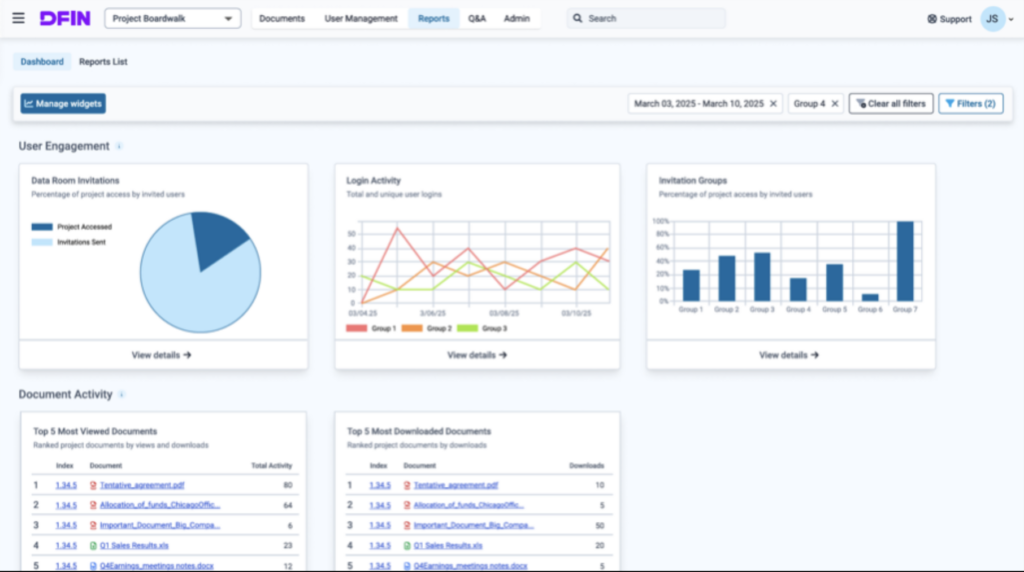
What stands out: When a deal and a filing run in parallel, both can sit with one provider. AI Document Summaries and AI Document Translation arrived in September 2026, which helps multilingual teams read a 200-page agreement quickly. G2’s product description also lists a Venue MCP Connector for outside AI tools.
What to check: The G2 sample is thin, and pricing needs a quote. DFIN highlights file-level page counts, so ask whether billing is page-based and how overages work. Confirm which AI functions and the MCP connector your plan includes.
Pricing: Custom quote.
Reviews: 4.4 out of 5 from 31 G2 reviews.
10. ShareVault: best for IP-sensitive and life sciences deals
Best for: Biotech, pharma and licensing transactions where clinical data and patents are the main assets.
What it is: ShareVault is a long-running data room focused on life sciences, with templates for partnering and licensing. It integrates with Box, Dropbox, Google Drive, SharePoint, OneDrive and DocuSign.
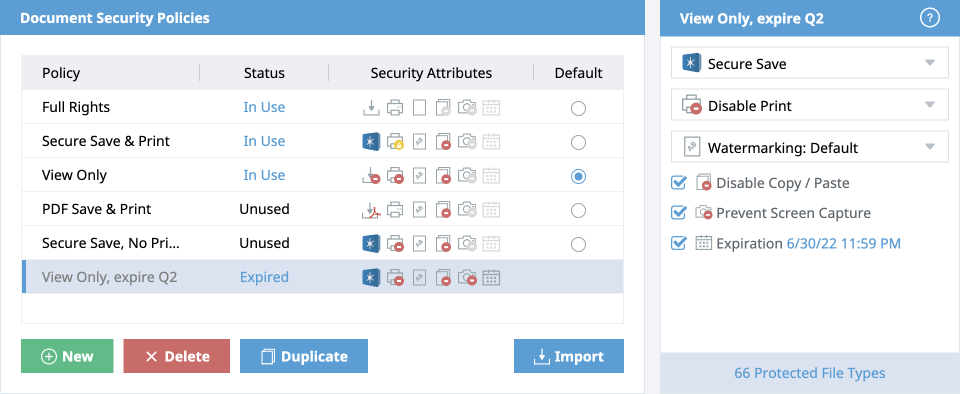
What stands out: ShareVault describes bulk AI redaction of personal and health information. A biotech sharing trial data with a licensing partner can strip identifiers in large batches instead of redacting page by page. Remote document shredding and dynamic watermarking address IP-leak concerns.
What to check: G2 reviewers mention a learning curve, interface complexity and unclear pricing. AI beyond redaction is limited, so it is not the pick if you want a conversational assistant.
Pricing: Tiered. An Express plan is listed publicly (third-party listings show about $199 a month), while Pro and Enterprise are quoted.
Reviews: 4.6 out of 5 from 91 G2 reviews.
Intralinks vs. competitors: key differences
Five things separate Intralinks from the alternatives above: how you are billed, how AI reaches the room, how much of the deal process the platform manages, who owns the vendor, and how reviewers rate it. Ownership deserves a note. Datasite owns Datasite, Firmex and Ansarada, and SS&C owns Intralinks. Teams that want a vendor outside both groups can look at Ideals, DealRoom, Drooms, DFIN Venue, ShareVault, SecureDocs or Digify.
The two tables summarise billing and AI. The head-to-heads that follow explain what each difference means in practice.
Pricing and contract terms compared (confirm all terms with the vendor)
| Provider | Pricing model | Public price | Main cost variables |
|---|---|---|---|
| SS&C Intralinks | Custom contract | Quote required | Product, document volume, duration, users |
| Ideals | Quote-based plans (Core, Premier, Enterprise) | Quote required | Storage, tier, project needs |
| Datasite | Custom contract | Quote required | Deal scope, term, modules |
| DealRoom | Annual, deal-volume-based | No public price | Number of deals, modules |
| Firmex | Per project or unlimited-rooms subscription | Quote required | Data volume, project length |
| Ansarada | Storage-based tiers | Published on vendor site | Storage tier, room duration |
| Drooms | Plan-based | Check current plans | Plan, users, AI tier |
| SecureDocs | Flat fee | From $250 a month | Plan term |
| Digify | Flat monthly plans | Pro and Team published | Rooms, users, protection add-ons |
| DFIN Venue | Custom | Quote required | Page counts, term |
| ShareVault | Tiered plans | Express listed, others quoted | Users, storage, features |
Every provider offers permission controls, so that column rarely decides anything. AI depth and outside-tool connectivity do. Where a feature could not be confirmed publicly, the table says so. For an AI-only comparison, see our guide to AI data room software for M&A due diligence.
Security, permissions and AI features compared
| Provider | Granular permissions | Redaction | AI document assistance | External AI connectivity |
|---|---|---|---|---|
| SS&C Intralinks | Yes | Yes | Link and Ask Link | DealCentre Connect |
| Ideals | Yes (eight levels) | Plan-dependent | AI search, folder creation, Q&A duplicates | MCP |
| Datasite | Yes | Yes | Blueflame, semantic search | MCP |
| DealRoom | Yes | Not publicly confirmed | Diligence and contract analysis | Reports conflict; confirm |
| Firmex | Yes | Yes | Not publicly confirmed | Not publicly confirmed |
| Ansarada | Yes | Yes | Ask AiDA | Not publicly confirmed |
| Drooms | Yes | Yes | Source-cited AI assistant | Not publicly confirmed |
| SecureDocs | Yes | Not listed | Not publicly confirmed | Not publicly confirmed |
| Digify | Yes | Not publicly confirmed | Not publicly confirmed | Not publicly confirmed |
| DFIN Venue | Yes | Verify by plan | AI summaries and translation | Venue MCP Connector |
| ShareVault | Yes | Yes | Not publicly confirmed | Not publicly confirmed |
Ideals vs Intralinks
Structure and billing. Ideals is one data room sold on storage-based plans. Intralinks splits into VDRPro and DealCentre AI on custom contracts, and sources report page-based metering in some of them. Ideals is easier to forecast, while Intralinks needs a written definition of how usage is counted.
AI. Ideals reaches outside assistants through MCP, so Claude, ChatGPT or Copilot works inside the room. Intralinks keeps AI in its own Link engine and adds DealCentre Connect for supported partners.
Fit. Ideals suits mid-market sell-side and buy-side diligence where outside bidders need a simple room. Intralinks suits processes where the banks expect its environment. Ideals scores 4.7 from 864 reviews, against 4.7 for DealCentre AI (119) and 3.8 for VDRPro (31).
Datasite vs Intralinks
Both target large, multi-party deals, and both price by quote. The split is scope and AI design.
Datasite spans preparation, outreach and diligence, and built its own agent after buying Blueflame AI. Its April 2026 MCP server lets outside assistants work on live content. Intralinks offers Link inside DealCentre AI and a gateway for partners such as Harvey, Legora and Hebbia.
G2 gives Datasite 4.5 from 451 reviews. Both draw cost complaints. Choose Datasite for one vendor from outreach to closing. Choose Intralinks when your counterparties already work in it.
Intralinks vs Dealroom
These are different tools. Intralinks is an exchange hub where many outside parties get controlled access. DealRoom is a workspace for the buyer, with pipeline stages, diligence requests and integration worklists.
Billing differs too. DealRoom charges by deal volume on an annual commitment, with unlimited users and storage and no per-page fees. Intralinks quotes custom contracts. A team closing six acquisitions a year may find DealRoom cheaper per deal. A one-time seller may not.
DealRoom’s AI centres on diligence and contract analysis, while Intralinks offers Link and Ask Link. Reported reviews are 4.3 on G2 (66) and 4.6 on Capterra (247).
Intralinks vs Firmex
The billing choice is the main difference. Firmex lets you pay per project or take an unlimited-rooms subscription, so a boutique with eight mandates avoids eight quotes. Intralinks uses custom contracts.
On AI, Intralinks has Link, Ask Link and DealCentre Connect. We could not verify a public Firmex assistant or MCP connector as of November 2026.
Firmex holds 4.6 on G2 (93 reviews), with comments about a dated interface. Choose Firmex for predictable multi-room work. Choose Intralinks for large regulated deals where AI and reach matter.
Ansarada vs Intralinks
Ansarada centres on auction preparation. It scores deal readiness, tracks bidder engagement and offers free preparation until bidders are invited. Its 97% prediction figure is a vendor claim, so test it on your own process.
Intralinks offers a wider platform with marketing, diligence and partner AI. G2 reviewers of Ansarada mention search glitches, missing functions next to competitors such as Intralinks, and high prices for small projects. It scores 4.5 from 238 reviews. Choose Ansarada when bidder insight drives your decisions.
Drooms vs Intralinks
Drooms differs on hosting and focus. The company says its AI runs on EU servers and does not train on live data. The assistant answers in the user’s language and links to source paragraphs. That suits European M&A and property deals.
Intralinks covers broader financial-services workflows, from capital markets to funds. Public review volume for Drooms is small, so ask for references. Verify hosting and subprocessors with both vendors.
SecureDocs vs Intralinks
Price and complexity separate them. SecureDocs publishes a flat fee from $250 a month with unlimited users and documents. Intralinks quotes custom contracts.
Reviewers do not list AI tools for SecureDocs, while Intralinks has Link. Capterra shows SecureDocs at 4.9 from 158 reviews. Choose SecureDocs for one buyer and a few dozen files. Choose Intralinks for multi-party, regulated deals.
Digify vs Intralinks
Digify protects files after sharing, with watermarks, expiry and view tracking. Plans are self-serve, entry pricing is listed from about $140 a month, and entry plans cap rooms and users. Q&A and dynamic watermarking sit on higher tiers.
Intralinks runs the full multi-party process. Capterra shows Digify at 4.8 from 179 reviews and G2 at 4.6 from 108. Choose Digify for tracked sharing with investors, and Intralinks for auctions.
DFIN Venue vs Intralinks
Venue ties the data room to SEC filing work through ActiveDisclosure. In September 2026 it added AI Document Translation and Summaries, and G2’s listing mentions a Venue MCP Connector.
Intralinks argues that Venue centres on the VDR while DealCentre AI covers more of the lifecycle. That is a vendor view, so check it in a demo. DFIN highlights page counts, so ask how billing works. G2 shows Venue at 4.4 from 31 reviews, a thin sample. Choose Venue when filings and the room share one provider.
ShareVault vs Intralinks
ShareVault specialises in life sciences and IP. Its bulk AI redaction of personal and health information suits clinical data. Pricing is tiered, with Express listed and Pro and Enterprise quoted.
G2 shows 4.6 from 91 reviews, with comments about a learning curve and unclear pricing. Intralinks suits bank-led transactions and fund workflows. Choose ShareVault for biotech licensing.
How to choose the right Intralinks alternative
Match the platform to your deal workflow
A sell-side auction with many bidders needs fast Q&A and engagement tracking, which points to Ideals, Datasite, Ansarada or Intralinks. A buyer running diligence across several targets wants a tracker, which points to DealRoom. Advisers with many small mandates tend to prefer Firmex. Life sciences fits ShareVault, and filing-linked work fits DFIN Venue. No single platform wins every situation.
Request comparable quotes and test key tasks
Ask each shortlisted vendor to quote the same scenario, then run the same tasks in a trial:
- Upload a realistic folder of mixed file types and time the indexing.
- Redact a batch of contracts and review the accuracy.
- Send ten buyer questions through Q&A, including one duplicate.
- Ask the AI assistant something its permissions should block.
- Export the audit trail and confirm that AI actions appear in it.
UK market: what Britain-based deal teams should check
UK dealmaking is getting narrower. PwC UK’s mid-year outlook shows deal volumes down almost 13%, while the ten largest transactions made up over half of deal value. With fewer deals, each mandate needs a room that is ready quickly and shows who is reading what.
Data protection rules moved too. The Data (Use and Access) Act 2025 introduced a “not materially lower” transfer test, and its main provisions took effect on 5 February 2026. The ICO’s guidance looks at where the receiving organisation is established, not only where servers sit. This is general information, not legal advice, so ask your lawyers. Put these questions to every vendor:
- Which hosting regions can we choose, and is the UK one of them?
- Where does AI processing happen, and does it match storage?
- Are our documents or prompts used to train AI models?
- Which transfer mechanism applies if data leaves the UK?
Frequently asked questions
Who are Intralinks’ main competitors?
Datasite, Ideals, DealRoom, Firmex, Ansarada, Drooms, DFIN Venue, ShareVault, SecureDocs and Digify appear most often on shortlists. The right pick depends on deal size, AI needs and how you prefer to pay.
What is the difference between Ideals and Intralinks?
Ideals sells storage-based plans with 24/7 support and MCP connections to Claude, ChatGPT and Copilot. Intralinks sells VDRPro and DealCentre AI on custom contracts, with Link and DealCentre Connect for AI.
Is Datasite better than Intralinks for M&A?
Not in every case. Both serve large, complex deals. Datasite offers Blueflame and an MCP server, while Intralinks offers Link and partner integrations. Counterparty familiarity often decides.
Is DealRoom or Intralinks better for corporate development?
DealRoom suits teams that run repeated acquisitions and want pipeline, diligence and integration together. Intralinks suits bank-led processes with many bidders.
Which is more cost-effective: Firmex or Intralinks?
Firmex’s subscription option is easier to forecast when you run many small projects. Intralinks prices by custom quote. Compare total cost, including extension fees and renewal terms.
How much do Intralinks alternatives cost?
Most providers quote on request. Published entry points include SecureDocs from $250 a month and Digify plans listed from about $140 a month. Confirm current prices and included features with each vendor.
Related Resources
Data rooms for M&A: UK comparison: features and providers for buy-side and sell-side deals.
Due diligence data room: best options in the UK: what to look for in a diligence-ready room.
Cheap virtual data room providers for UK deals: lower-cost options for smaller transactions.